


Beyond the Engraving: Three Stories from the SurCutEngraving Workshop

There is a tendency to think of laser engraving as a straightforward process.
Take an object. > Add some text. > Press a button. > Done.
In reality, the finished engraving is often only the visible part of the story.
The projects that come through our workshop can have very different reasons behind them. Some are deeply personal. Some are connected to a company's history or identity. Others exist simply because someone wants to experiment with an idea.
Recently, we had all three.
And together, they are a good example of what we enjoy about custom laser work.
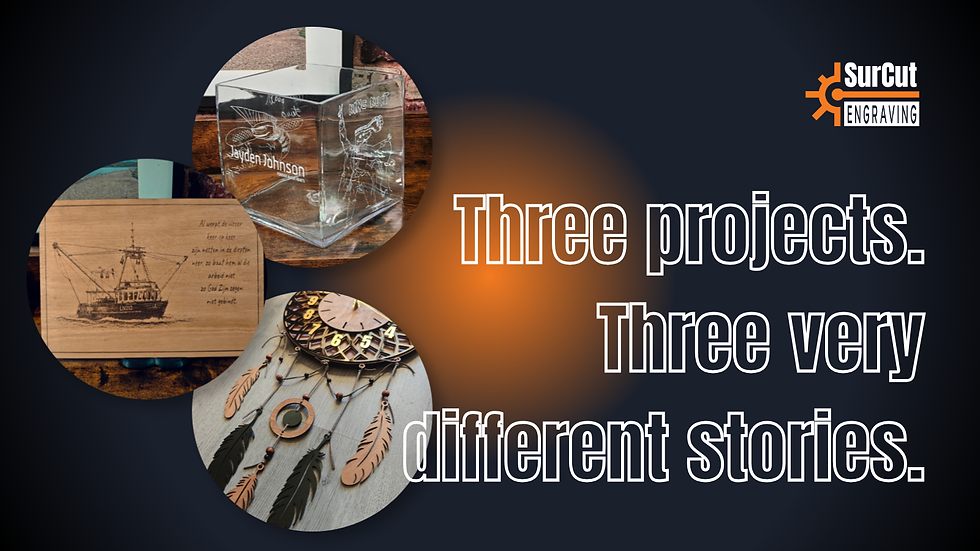
A piece made to remember someone
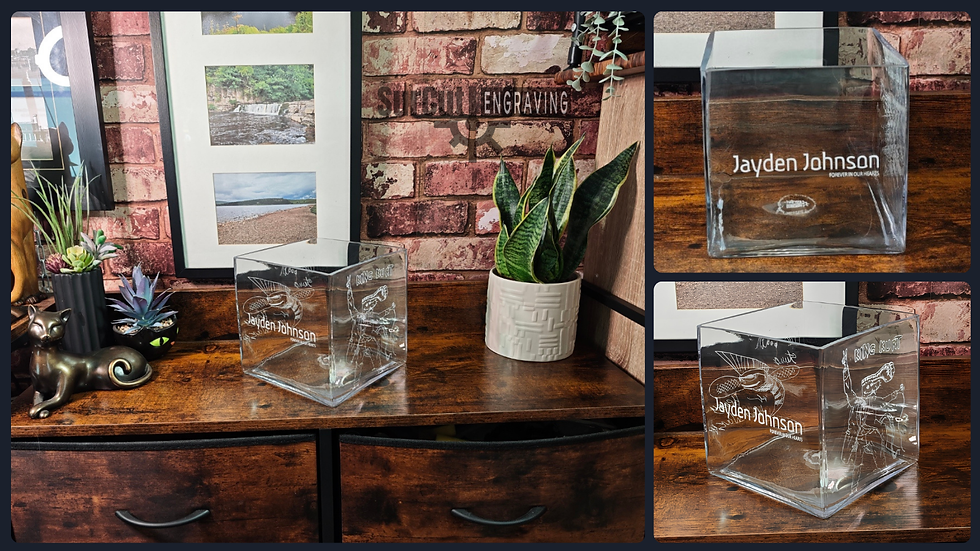
The first project was a glass vase.
It was commissioned by Jayden's colleagues following his passing. They wanted his name and drawings incorporated into the vase as a way of keeping his memory present.
The finished vase combines his name with drawings, engraved directly onto the glass.
Glass has its own character as an engraving material. The finished appearance depends not only on the artwork, but on how that artwork interacts with transparency, reflections and the surrounding light.
But this wasn't primarily a technical exercise.
The technical decisions simply had to support the reason the piece was being made in the first place.
That is something we find particularly interesting about personalised work.
The object may be made from glass, wood or acrylic.
The engraving may be produced by a machine.
But the reason someone wants it can be completely human.
In this case, it was about remembering someone.
When the subject of the engraving already has a story
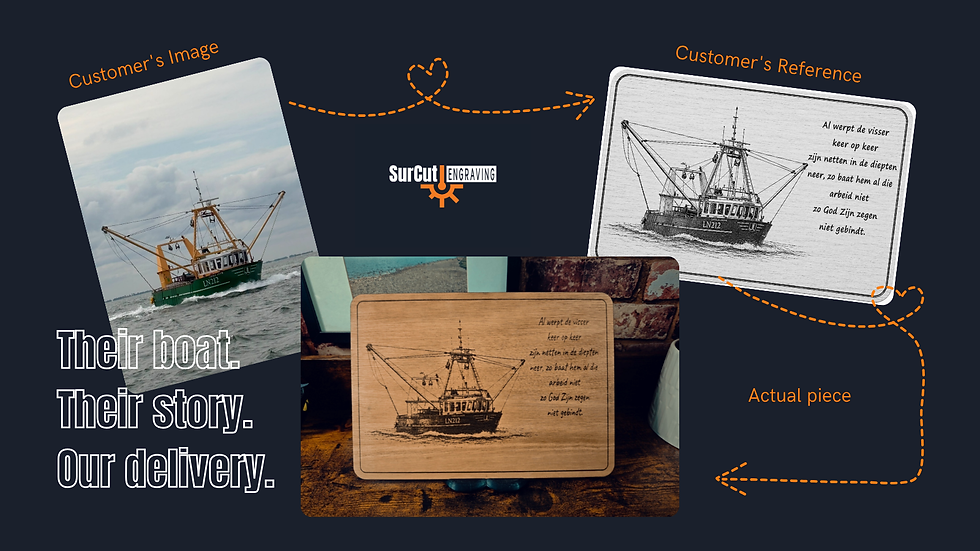
The second project was a wooden plate.
At first glance, the main image might simply look like a fishing vessel.
It isn't.
The artwork represents a real vessel belonging to a company connected with the customer's family.
The customer had previously commissioned similar engraved pieces from another local supplier over a number of years.
For this project, he wanted an A4-sized plate featuring the vessel together with accompanying text.
There were concerns about whether the desired level of detail could be maintained at that size, so the customer looked for another option and found us through Google.
We produced the plate and were pleased with the level of detail achieved in the finished engraving.
The response from the customer was equally positive, and he told us he plans to bring future engraving work to us.
The finished piece is now heading to the Netherlands.
What makes this particular project interesting isn't just the engraving itself.
The subject already had a connection to the customer and his family.
It wasn't a generic boat selected from a library of images.
It was their boat.
That changes the character of the finished object.
A piece of equipment, a vehicle, a building, a product or a familiar place can all become meaningful source material when it is connected to the people or organisation behind it.
And then there are the experiments
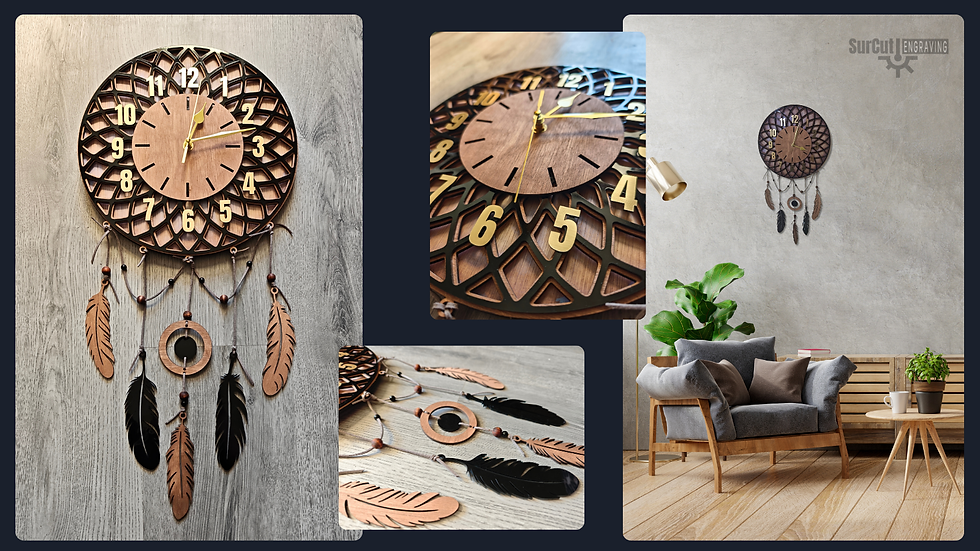
The third project wasn't an order at all.
It was something we made to see what might happen.
We've been experimenting with combining wood and acrylic in layered designs, and this wall clock was one of the trial pieces.
It's not being presented as a finished product line.
It's an experiment.
And experiments are useful precisely because they don't have to start with a completely defined answer.
How do the materials work together?
How much layering is enough?
How does the design change when different materials sit at different depths?
What happens when a practical object, such as a clock, becomes an opportunity for decorative construction as well?
The first version doesn't need to answer all of those questions.
It simply needs to give us something to look at, evaluate and potentially improve.
That is one of the less visible sides of laser cutting and engraving.
The machine is only one part of the process.
There is also artwork preparation, material selection, composition, scale, testing and — sometimes — making something simply because we want to find out whether it works.
Three projects. Three reasons for making something.
Looking at these three pieces together, they represent three very different sides of our work.
The vase was about memory.
Creating something that could hold a personal connection to someone who had passed away.
The wooden plate was about meaning and identity.
Taking a real vessel with an existing connection to a family and company and turning its image into a physical piece.
The clock was about exploration.
Trying a combination of materials and seeing where the idea might go.
They don't have much in common as objects.
But they have something important in common as projects.
They all started with something beyond the engraving itself.
A person.
A story.
An object.
An idea.
And that's probably the part of custom work we enjoy most.
We care about the meaning behind the work.
Because the best engraving isn't necessarily the most complicated one.
Sometimes the most important part is understanding why the piece is being made.
We solve difficult production problems.
Size, material, artwork, detail and composition can all create their own challenges. Finding a way to make the finished piece work is part of the process.
And we're constantly experimenting with what we can make.
Not every experiment becomes a product.
Not every idea needs to.
Sometimes the value is simply discovering what is possible.
And then seeing where the next idea takes us.

Comments